:: MAIN MENU ::
:: JOURNAL ACCREDITATION ::
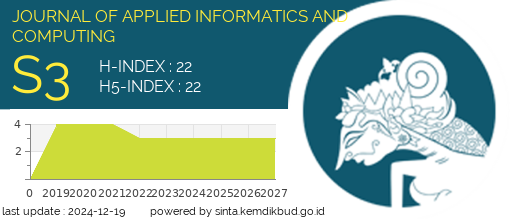
Download: SK No. 79/E/KPT/2023

:: SUBMIT YOUR PAPER ::

The Journal of Applied Informatics and Computing (JAIC) is committed to maintaining academic integrity, originality, and ethical publishing practices. All manuscripts submitted to JAIC must represent original scholarly work and appropriately acknowledge the ideas, words, data, methods, and findings of other researchers.
JAIC does not tolerate plagiarism, self-plagiarism, or other forms of inappropriate reuse of previously published material. All submitted manuscripts are subject to plagiarism and similarity screening before being sent for peer review.
JAIC uses iThenticate as a similarity detection tool to assist the editorial team in identifying potential plagiarism and inappropriate textual overlap. Manuscripts are screened by a member of the editorial team during the initial editorial assessment.
The journal applies the following similarity requirements:
Overall similarity index: Less than 20%.
Similarity to an individual source: No more than 3% from any single source.
Manuscripts that exceed these thresholds may be returned to the authors for clarification or revision, subjected to further editorial assessment, or rejected, depending on the nature and extent of the identified overlap.
The similarity index is an initial screening indicator and does not, by itself, establish whether plagiarism has occurred. The editorial team examines the similarity report to determine whether matching text represents legitimate quotations, standard terminology, references, methodological descriptions, improperly attributed material, or other potentially problematic overlap.
Conversely, a manuscript with a similarity score below the specified thresholds may still be rejected if the editorial assessment identifies plagiarism or other serious breaches of publication ethics.
Authors are encouraged to check their manuscripts carefully before submission to ensure that all sources are appropriately cited and that reused material complies with applicable copyright and publication-ethics requirements.
Plagiarism occurs when an author presents another person's words, ideas, data, results, or other intellectual contributions as their own without appropriate acknowledgment, attribution, or citation. It may occur through direct copying, substantial reproduction, inappropriate paraphrasing, or other forms of unattributed reuse.
JAIC recognizes the following forms of potential plagiarism:
Direct plagiarism occurs when an author copies words, sentences, paragraphs, figures, tables, or other material from another source without appropriate quotation, attribution, or permission where required.
Both complete and partial copying may constitute plagiarism, depending on the circumstances and the nature of the material used.
Substantial plagiarism involves reproducing a significant portion of another person's work without proper acknowledgment. Substantiality may be assessed in terms of both quantity and quality, including the significance of the copied material in relation to the original work and the submitted manuscript.
A relatively small amount of copied material may still constitute a serious ethical violation if it represents a central idea, a significant finding, or another important intellectual contribution.
Paraphrasing involves expressing ideas or information from a source in different words. It becomes plagiarism when the original source is not appropriately cited or when the paraphrasing remains so close to the original wording or structure that it misrepresents the source's contribution.
Changing a few words, rearranging sentences, or translating text from another language does not eliminate the obligation to acknowledge the original source.
Self-plagiarism occurs when authors reuse substantial portions of their own previously published work without appropriate citation or transparent disclosure. It may include copying text, reusing previously published results, or presenting substantially overlapping work as new and original research.
Authors must disclose relevant overlap with their previous publications and clearly identify any reused material. Reuse of an author's own work does not automatically constitute misconduct in every case; the editorial team evaluates the extent of overlap, the nature of the reused material, the adequacy of disclosure, and the applicable publication and copyright requirements.
Plagiarism may also involve using another researcher's ideas, research designs, methods, datasets, figures, tables, images, or findings without appropriate attribution. Authors must cite the relevant sources and obtain permission where required by copyright, licensing terms, or other applicable requirements.
When potential plagiarism or inappropriate similarity is identified, the editorial team will evaluate the evidence and determine the appropriate action based on the seriousness and circumstances of the case.
Possible actions include:
Requesting clarification or a revised manuscript from the authors.
Returning the manuscript for correction of citation, quotation, or attribution problems.
Rejecting the manuscript if serious plagiarism or other ethical violations are established.
Suspending the editorial process while the concern is investigated.
Taking appropriate post-publication action, such as issuing a correction, an expression of concern, or a retraction, when warranted.
Where necessary, JAIC may contact the authors' affiliated institutions or other relevant parties to seek clarification or support an investigation. Editorial decisions will be based on the available evidence and the journal's publication-ethics policies.
Authors submitting manuscripts to JAIC are responsible for:
Ensuring that their work is original and has not been improperly copied from other sources.
Citing all sources used in the manuscript accurately and consistently.
Using quotation marks and appropriate citations when reproducing exact wording.
Paraphrasing source material appropriately and providing the necessary citations.
Obtaining permissions for copyrighted material when required.
Disclosing relevant overlap with their own previously published work.
Ensuring that all co-authors are aware of and comply with this policy.
Submitting a manuscript to JAIC constitutes the authors' acknowledgment that the manuscript may be screened for similarity and assessed for potential plagiarism.
This policy applies to all manuscripts submitted to the Journal of Applied Informatics and Computing (JAIC), including research articles, review papers, and other scholarly contributions.
The JAIC Editorial Board is responsible for implementing and periodically reviewing this policy to maintain high standards of academic integrity and responsible scholarly publishing.




Organized by : Department of Informatic Engineering Politeknik Negeri Batam
Published by : Politeknik Negeri Batam
Jl. Ahmad Yani, Batam Center, Batam 29461
Phone: +62 778 469856 Ext 1041
E-mail: [email protected] | [email protected]

JAIC is licensed under a Creative Commons Attribution-ShareAlike 4.0 International License.